
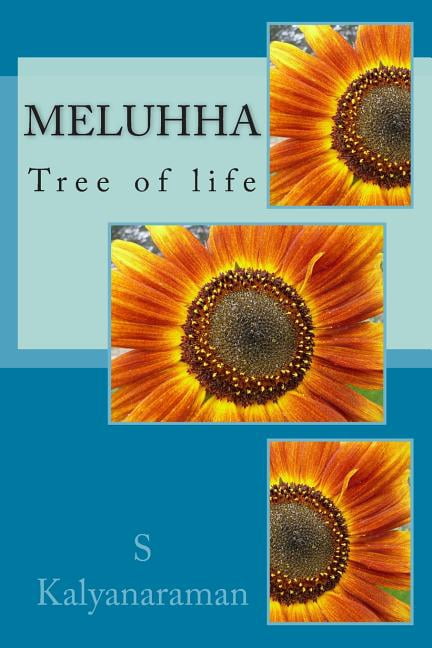
Meluhha: Tree of Life (Paperback)
Produktdetails
| Artikelnummer | 240534300 | Erscheinungsdatum | 2026/07/16 | Listenpreis | €4.00 | Modellnummer | 240534300 | ||
|---|---|---|---|---|---|---|---|---|---|
| Kategorie | |||||||||
Hieroglyphs are sacred carvings incised, to convey rebus substantive messages in Meluhha. Symbols associated with divinities and tree of life are Meluhha sacred carvings. Many carvings relate to specific varieties of plants, buds, flowers which are associated with sacredness because they connote -- rebus -- metal artifacts of a kole.l 'smithy/forge' which is, kole.l 'temple'. Archaeological evidences from Ancient Near East point to the practice of worship in temples of divinities associated with these hieroglyphs. Kabbalah of the Ancient Near East is a synonym of agama of Indian tradition with the roots found in Meluhha as a visible language. Both traditions venerate altars as models of temples. What lessons can be learnt from the evidences to delineate the roots of religious experiences of our ancestors? This inquiry primarily based on archaeologically attested artifacts is an incomplete religious inquiry. Kabbalah is a school of thought, a magnificent statement resulting from an intense inquiry into the nature of phenomena including living and non-living forms and cosmic order. One thought is apparent and central. There is some energy which permeates the universe and a name ws given to this energy, calling it by various appellations includes divine creation which can only be modeled on hieroglyphs. The hieroglyphs then become attributes of that divinity manifested in the cultural world order. When the king kneels in adoration in front of an altar which has as the center-piece a mere staff or pole, how did he vocalise the phenomenon which the sculpture has created? Is the sculpture an attempt at representing thought resulting from the inquiry? Or is it just a limited manifestation of the sculptor's life-experience? Or, is it a model of the ziggurat, the temple itself? Ziggurat as a temple is a leap in inquiry. It is a mere accumulation, a piling up of dhatu, earth forms containing minerals and what is left of minerals, may be ashes, after the processes in the crucible, smithy and forge. Or, is it a memory of accumulated memories bequeathed by ancestors in a life-continuum? The agama tradition in ancient India also has its roots in inquiry resulting in representation of attributes in human and non-human forms in an architectural model of a temple. The story of the agama and the kabbalah has to be fully told to understand the boundaries of the sacred observed and practised as religious experience. What is the difference between hakira (philosophy) and darash (inquire, seek ) Is the darash traceable to the Indian traditions of dars'ana? How do Rabbinic meanings ( midrashic) explain the traditions evolved over time, narrated in Tanakh? Is there a cosmic law? The sememe dars'an has its root dRs', 'to see'. Is the seeing mere visual experience or an experience of the conscious mind? The beholding could be a series of flashes or glimpses seen by the inquirer. The cognate wor darash thus becomes a series of events, related or unrelated. events of conscious thought of the devotee. A fantastic metaphor emerges in the Vis'warupa, divine, wondrous manifestation holding many weapons, ornamented with celestial flowers and perfumes. Before such a form, the devotee kneels down in adoration, like Tukulti-Ninurta I (1243-1207 BCE), King of Assyria or like Arjuna in front of Sri Krishna as narrated in the Mahabharata and the Gita. Is there any significance or meaning assignable, from a narrative, which refers to artifacts of gypsum, strong copper and the Magilum boat of Meluhha fame, apart from Anzu who had stolen the tablet of destiny? It appears that Meluhhan artificer who created a writing system referred to strong copper by using the rebus metaphor of the sunflower, karaDa which also connoted 'strong copper' or hard alloy.
Meluhha: Tree of Life (Paperback)| Book format | Paperback |
|---|---|
| Fiction/nonfiction | Non-Fiction |
| Genre | Religion |
| Publication date | November, 2013 |
| Pages | 186 |
| Edition | Standard Edition |
| Publisher | Amazon Digital Services LLC - KDP Print US |
| Original languages | English |
| Language | English |
| Awards won | Vakankar Award (2000), Shivananda Eminent Citizens' Award (2008), Dr. Hedgewar Prajna Samman (2008) |
| Assembled product height | 1.5 in |
| Assembled product weight | 1 lb |
| Bisac subject heading | Religion |
Korrektur der Produktinformationen
Wenn Sie Unvollständigkeiten oder Fehler in den Produktinformationen auf dieser Seite bemerken, nutzen Sie bitte das Korrekturformular unten.
Korrekturanfrage